Yahoo Edgecast, Session-Based Playback
Launching DVR-like playback controls for enterprise live streaming without the infrastructure overhead
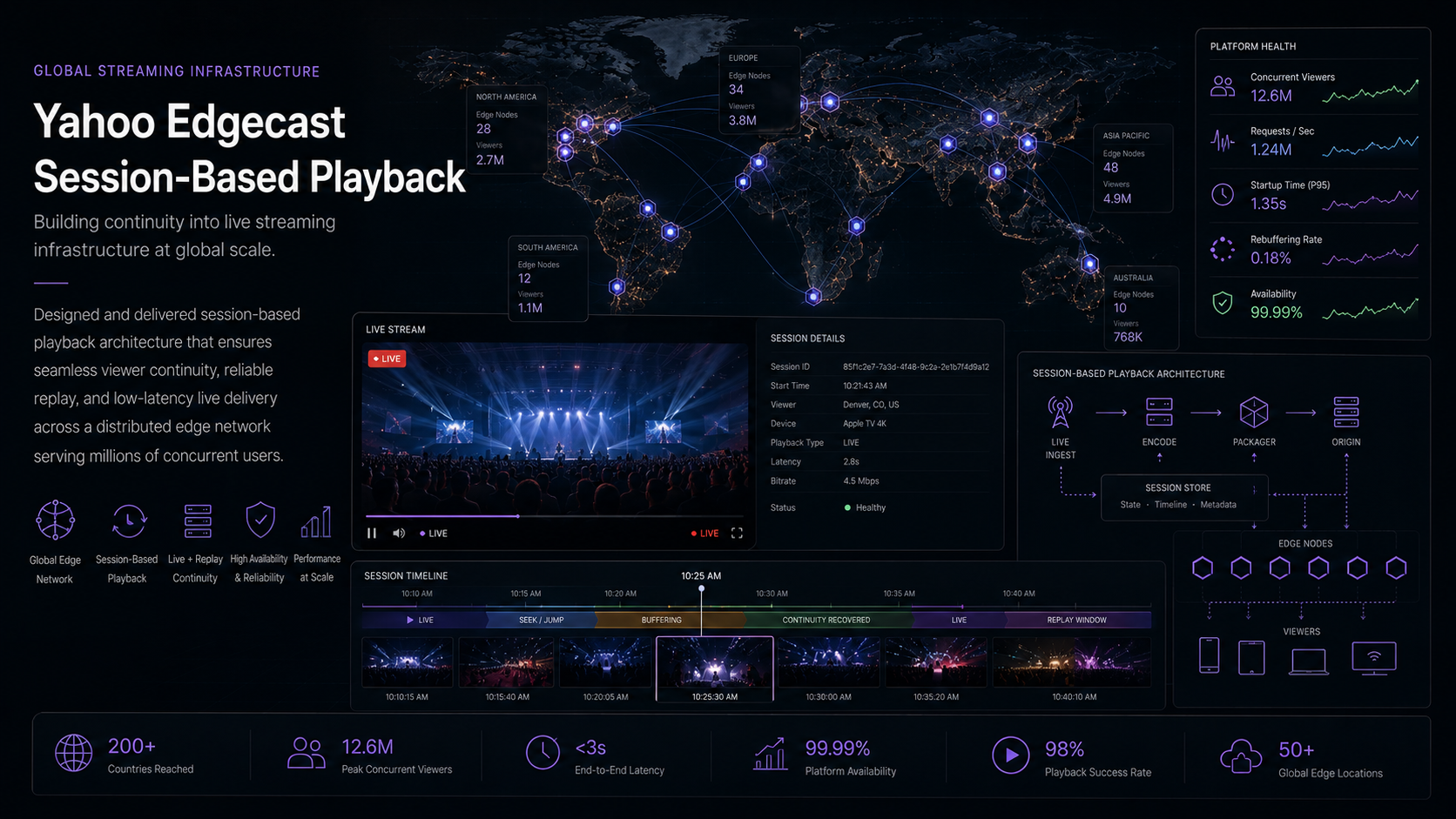
TL;DR
Live-stream viewers had no way to pause, rewind or replay. It was a growing retention risk. I led the zero-to-one launch of session-based playback, driving a 35% engagement lift while reducing cloud storage costs by 18%.
The Challenge
Live viewers expected DVR controls. Our platform offered none. Competitors shipped playback controls and our renewal pipeline felt it. Enterprise customers wanted pause, rewind and catch-up. Missing those controls meant viewers either watched live or lost the moment. The infrastructure-first instinct was to build persistent DVR at substantial cost. But the real problem was retention and renewals economics, not technology. I needed to deliver the user experience without the infrastructure cost.
Key Decisions
Reframe the problem as retention, not infrastructure. The initial instinct across the org was to treat this as a technical challenge: build DVR. I repositioned it as a business risk, making the case to leadership that every month without playback controls was measurable churn exposure. That reframing unlocked executive sponsorship and cleared competing priorities from the roadmap.
Design around session-level caching. Instead of standing up persistent DVR storage, I proposed a session-based caching model that gave viewers playback controls within their active session. This delivered the core user experience at a fraction of the infrastructure cost, because cached segments expired naturally rather than accumulating indefinitely.
Unify engineering, UX and business stakeholders early. CDN architecture and player UX were making decisions independently, which had already produced a caching design that would have broken the player’s seek behavior under load. Establishing a shared coordination structure and linking technical decisions to business risk meant tradeoffs were made with shared context rather than siloed assumptions. That early alignment prevented a class of integration failures that typically surface late and are expensive to fix.
Layer in compliance and delivery optimization. Launching playback controls created an opportunity to address adjacent gaps. I bundled EU-compliant geoblocking and multi-CDN delivery optimization into the same initiative, ensuring we shipped a more complete and resilient platform rather than a narrow feature.
What I Delivered
Session-based playback. A zero-to-one launch that gave live-stream viewers pause, rewind and replay capabilities within their active session. The architecture avoided the cost and complexity of traditional DVR by leveraging session-level caching pipelines that scaled efficiently with viewer volume.
Multi-CDN optimization. Improved delivery reliability and performance by distributing traffic intelligently across CDN providers, reducing single-point-of-failure risk and improving viewer experience during peak load.
EU-compliant geoblocking. Content restriction controls that met European regulatory requirements, enabling the platform to serve geo-sensitive content without manual intervention or legal exposure.
Caching architecture. The underlying session-caching pipeline that made the entire initiative economically viable, designed to handle high-concurrency live events while keeping storage costs predictable.
Outcomes
User engagement jumped 35% within months of launch. Viewers who previously bounced during live events were now staying, rewinding and catching up. Cloud storage costs dropped 18% compared to projected DVR infrastructure spend, validating the session-caching approach as both technically sound and financially disciplined. Delivery timelines accelerated by 50% as the multi-CDN optimization reduced bottlenecks in the content pipeline. Faster delivery translated directly into lower buffering rates and higher viewer session completion. The platform also modernized its competitive position: playback controls moved from a missing feature to a differentiator in enterprise sales conversations and directly reduced the churn risk that had motivated the initiative. The retention work held $5M in enterprise renewals through two ownership transitions, with Disney and Discovery renewing against a roadmap that had been re-sequenced around what kept customers, not around what engineering had already started building.
CDN vendors sell infrastructure. The PMs who win in streaming think in viewer retention economics.