Splunk, Security Content Platform
Unifying detection content discovery, adoption and automation for enterprise security teams
TL;DR
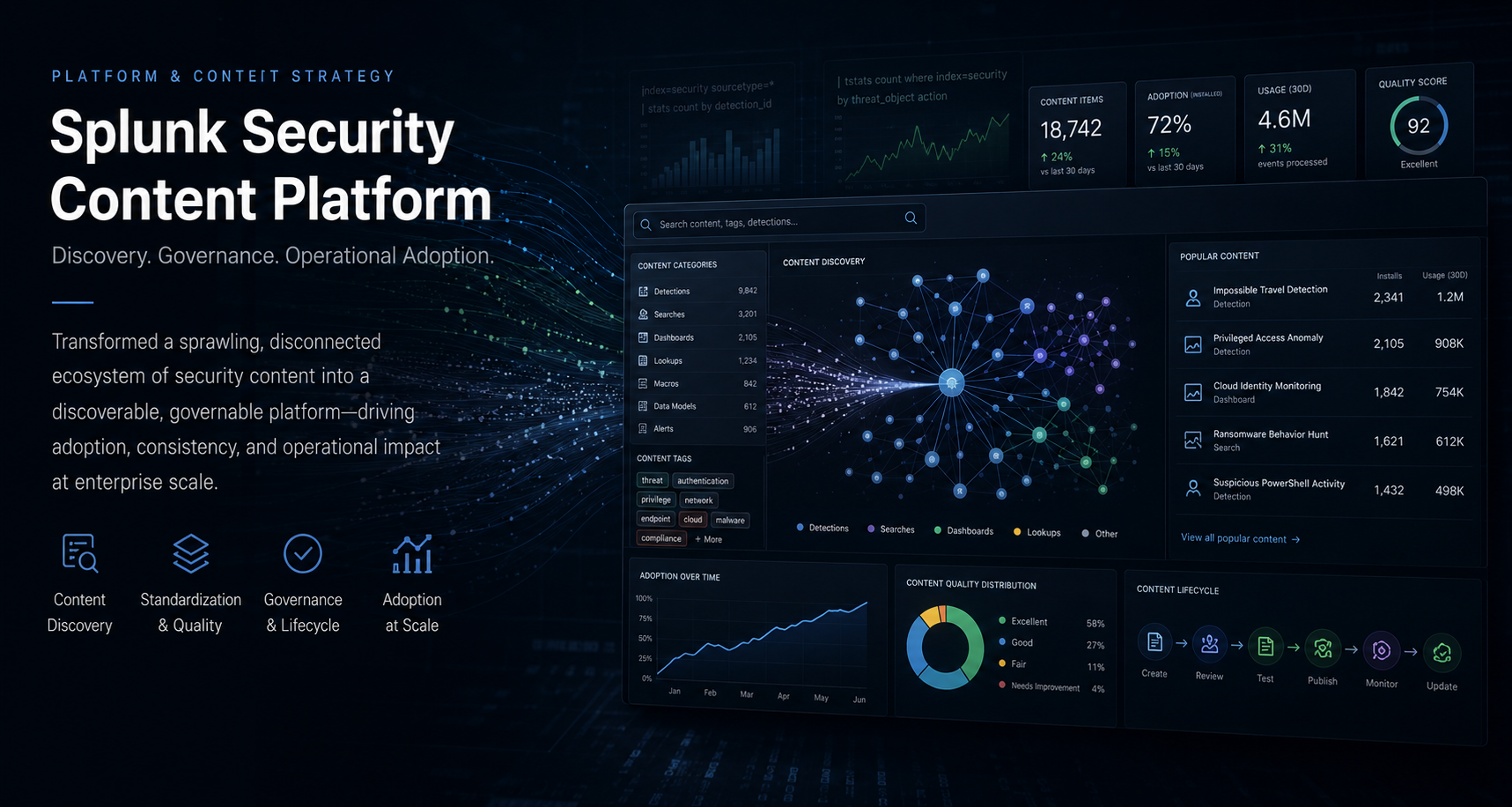
Security customers struggled to find and adopt detection content scattered across 3 systems. I unified engineering and product around a centralized discovery platform, driving a 12% adoption lift and cutting onboarding from 10 weeks to 3.
The Challenge
Content lived across 3 disconnected systems with inconsistent versioning. Detection updates arrived through 3 different interfaces. Onboarding took 10 weeks. Customers couldn’t tell if they were running the latest protections and support teams fielded the same questions repeatedly. The structural problem: no single source of truth.
Key Decisions
Consolidate to one content source before adding features. The case for a single discovery platform was obvious to product, but the resistance was real. Three content sources had 3 sets of internal owners, and deprecating existing workflows meant owning the migration risk. I made the call to tackle consolidation first rather than building on top of the fragmented topology, which would have compounded the problem with every subsequent release. The alternative (adding a unified interface as a fourth layer while keeping the 3 systems underneath) was on the table and rejected specifically because it would have deferred the root cause indefinitely. I scored the 3 options against adoption impact, migration complexity and time-to-measurability: consolidation ranked 1st on impact and last on political ease, which is exactly why it needed explicit executive alignment before it could move.
Instrument adoption, not just delivery. Shipping content is not the same as customers actually using it. I introduced adoption success metrics and content health tracking so we could see, for the first time, the gap between what we published and what customers activated. This reframed internal conversations from “we shipped it” to “they adopted it” and made the 12% adoption lift visible in a way that would have been unmeasurable otherwise.
Force automation onto the roadmap over manual fixes. Manual version tracking was the bottleneck nobody wanted to own. It was painful but familiar. There was organizational appetite to address it through better documentation and process. I pushed back and drove automated version control into the ES 8.0 roadmap instead, making the case that a process fix would decay over time while an automated system would compound. It was a harder engineering commitment to secure but the right call.
Redesign onboarding as a product surface, not a services handoff. Onboarding had been treated as a customer success problem: a white-glove process that needed more headcount to scale. I reframed it as a product failure. The platform wasn’t surfacing the right content at the right moment, so customers needed hand-holding to compensate. Re-engineering the workflows as a first-class product experience compressed ramp-up from 10 weeks to 3 without adding CS capacity.
What I Delivered
Centralized discovery platform. A single interface replacing 3 disconnected content systems: a consolidation that required retiring existing workflows rather than layering on top of them. Security teams could now find, evaluate and activate detection content with clear versioning and health indicators.
Automated version tracking at scale, Built into Enterprise Security 8.0 after pushing the commitment through a roadmap that initially favored process solutions. This removed the manual overhead that had slowed content updates and eliminated an entire class of version-mismatch support escalations.
Onboarding redesign, A product-first reengineering of the customer ramp-up workflow that cut time-to-value from 10 weeks to 3. Redundant gates were removed, critical configuration steps front-loaded and content coverage made visible from day one.
Adoption and health metrics. A measurement framework giving product and customer success a shared view of content activation rates: the instrumentation that made the adoption gap visible and made the 12% lift measurable.
Outcomes
12% increase in security content adoption within 6 months. Meaningful movement in an enterprise environment where behavior change is slow and customers rarely change workflows without a forcing function. Onboarding time dropped 70%, freeing customer success capacity and improving time-to-value for new accounts. The adoption metrics I introduced became a standing artifact in quarterly business reviews, shifting the organization’s definition of success from content shipped to content activated. Automated version tracking eliminated an entire class of support escalations that had been a recurring drain on the customer success team.
Security content is a product problem, not a services problem. Most vendors still haven’t realized it.