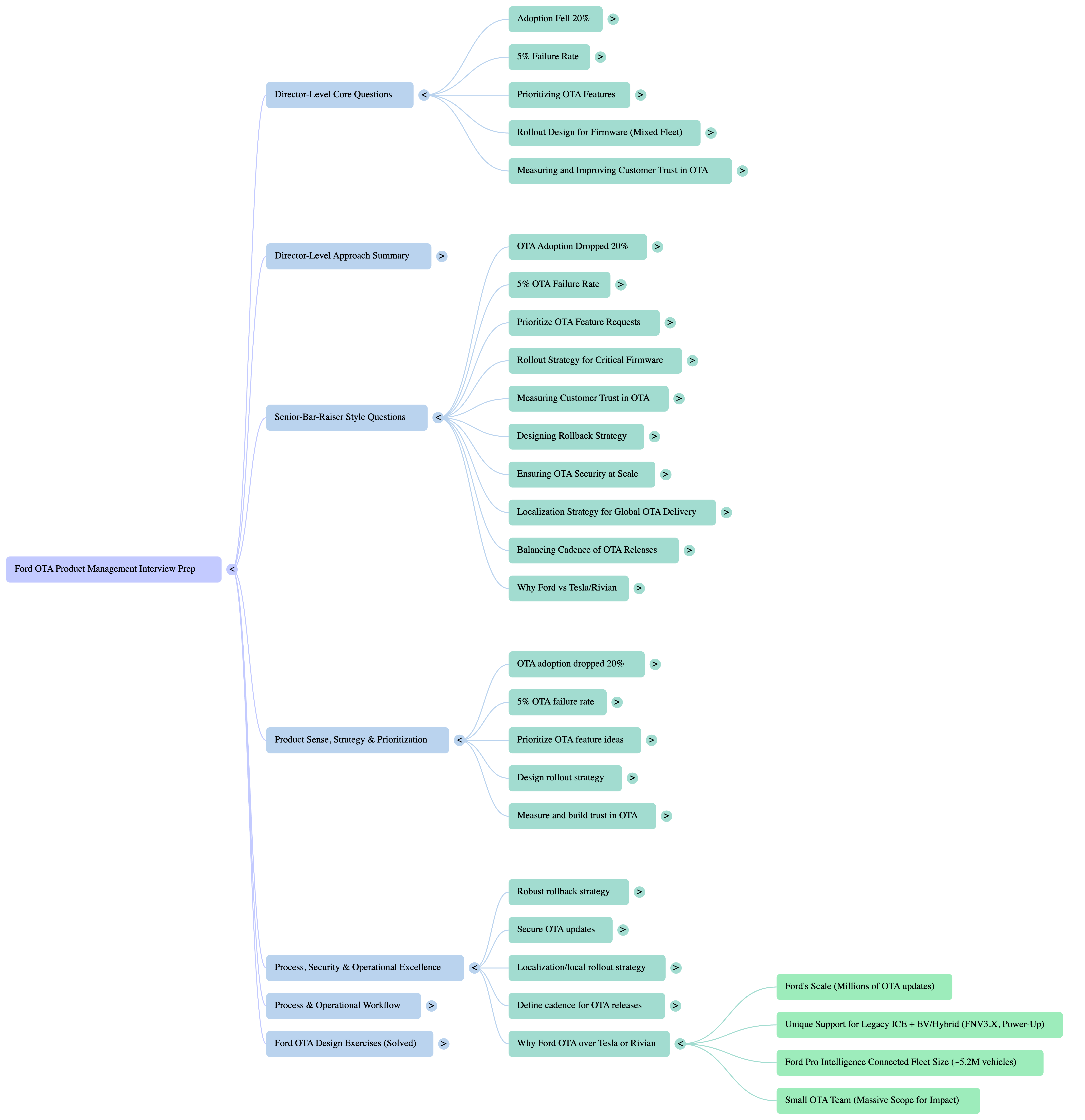
Ford Power-Up OTA Strategy
Repositioned Ford's over-the-air update system from a reactive support burden into a competitive differentiator across retail and commercial segments.
The Challenge
As connected vehicles became more software-defined, Ford’s Power-Up OTA system emerged as a critical customer touchpoint — and a growing source of friction. Retail customers reported update failures that eroded trust. Fleet managers faced costly downtime when updates went wrong. The update experience, rather than reinforcing Ford’s technology leadership, was quietly undermining it.
The root causes ran deep. Fragmented ECU software across a mixed powertrain fleet meant updates behaved unpredictably across vehicle types. Missing rollback safety nets turned minor failures into stranded-vehicle events. And 12V battery charge failures — a seemingly mundane issue — accounted for a disproportionate share of update interruptions. Ford needed more than a bug-fix cycle. It needed a strategic repositioning of the entire OTA experience.
My Approach
I led a full end-to-end strategic exploration, starting with a teardown of Ford’s OTA experience across three lenses: customer pain points, technical architecture, and operational impact. The goal was to move beyond symptomatic fixes and identify the structural gaps that made the system fragile.
Failure-to-cost mapping — I traced OTA failure modes to their downstream financial impact, quantifying fleet downtime at $400–$760 per vehicle per day and dealer support escalations at $500–$1K per incident. These numbers reframed OTA reliability from a quality metric into a business case that could command executive attention.
3-pillar recovery framework — From the teardown findings, I proposed a recovery strategy organized around three pillars: trust-building UX patterns that give customers visibility and control during updates, platform safety mechanisms including rollback architecture and pre-update health checks, and fleet management tooling purpose-built for mixed-fleet orchestration at scale.
Trust-anchored UX patterns — I designed update experience flows that prioritized transparency — clear progress indicators, pre-update readiness checks surfaced to the driver, and post-update confirmation that communicates what changed and why. The insight was that trust isn’t rebuilt by making updates invisible; it’s rebuilt by making them legible.
Data-backed roadmap — I built a phased strategic roadmap targeting a 50% reduction in OTA failure rates within high-friction cohorts, sequenced to deliver early wins in battery-related failures before tackling the harder ECU fragmentation challenges.
What I Delivered
OTA teardown analysis — A comprehensive diagnostic mapping every major failure mode to its root cause, customer impact, and operational cost. This became the shared reference point for prioritization decisions.
3-pillar recovery framework — A strategic architecture that organized dozens of improvement opportunities into three coherent workstreams, each with clear ownership boundaries and success metrics.
Strategic roadmap — A sequenced delivery plan that balanced quick wins against structural improvements, with built-in checkpoints to validate that failure-rate reductions were tracking before investing in later phases.
Reusable fleet architecture — A reference design for mixed-fleet orchestration, rollback safety, and predictive scheduling that could extend beyond Power-Up to future connected vehicle programs.
Key Takeaways
The biggest lesson from this exercise was that OTA isn’t a feature — it’s infrastructure that touches every part of the customer relationship with a connected vehicle. Treating it as a background utility is what allowed trust to erode in the first place. The path forward required thinking about OTA the way Ford thinks about powertrain: as a core system that defines the ownership experience, deserving of its own product strategy and dedicated investment thesis.