ESPN, Streaming & Ad Monetization
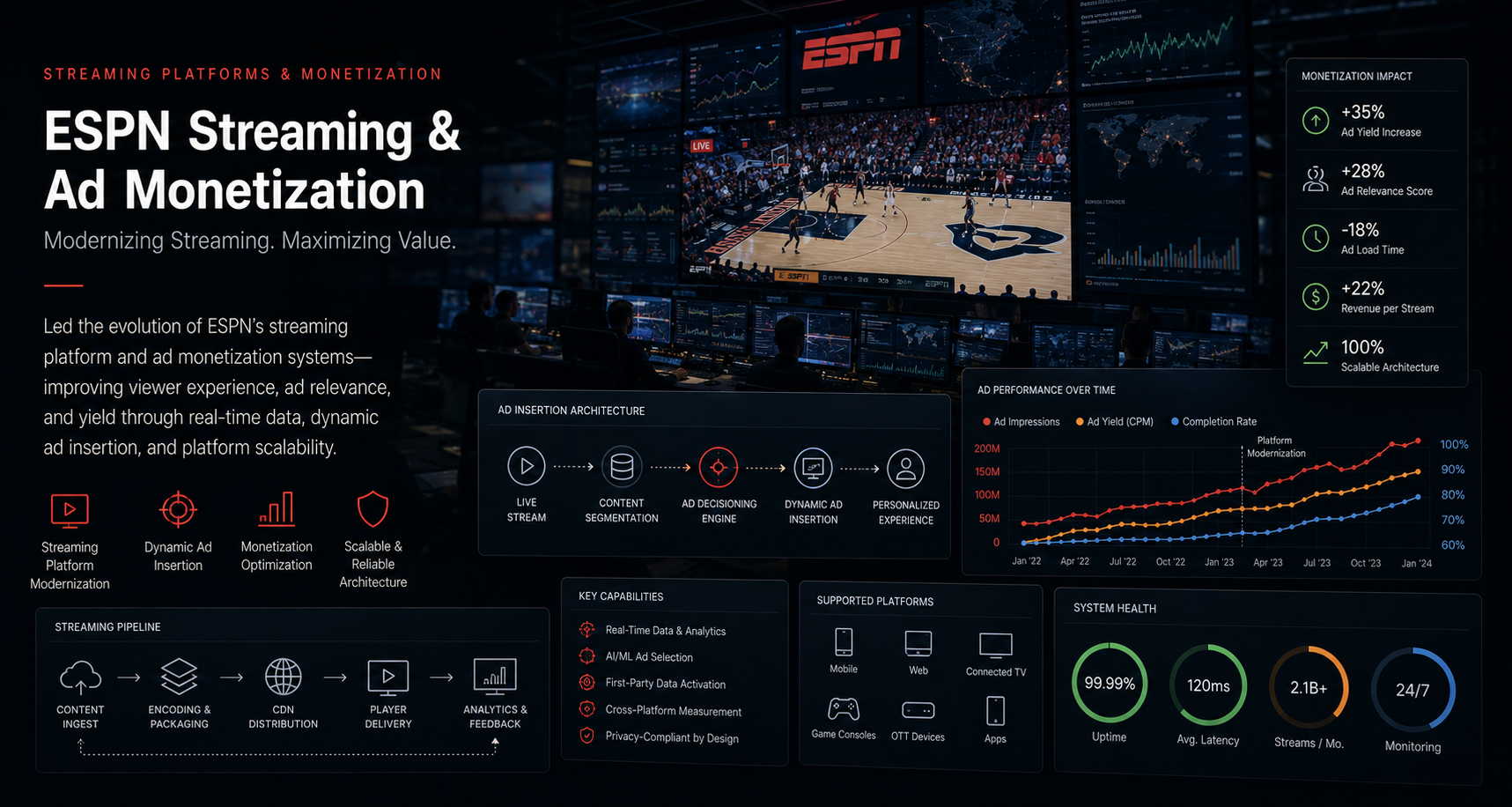
Led ESPN's platform transformation from Flash to HTML5 streaming, architected for 4K scalability and drove a strategic ad tech pivot from FreeWheel to Google Ad Manager.
TL;DR
Led ESPN's migration from Flash to HTML5 live streaming, drove a 25% uplift in video engagement and 60% increase in ad insertion success and architected the platform pivot from FreeWheel to Google Ad Manager across Disney.
The Challenge
By 2017, ESPN’s streaming infrastructure was running on borrowed time. The legacy Adobe Flash video players that powered live and on-demand content were approaching end-of-life and the ad insertion stack built on top of them was underperforming in ways that directly hit revenue. Viewers were demanding 4K content and seamless playback. Ad insertion failures were leaving money on the table with every stream. And the gap between where the platform was and where it needed to be was widening with every quarter.
The problem wasn’t just technical debt, it was strategic debt. ESPN needed a modern streaming foundation that could support the next generation of live sports broadcasting while simultaneously fixing an ad monetization pipeline that wasn’t delivering on its potential. Doing one without the other would leave half the problem unsolved.
Key Decisions
Leading with the player migration. Directed the vendor evaluation, player migration and rollout of ESPN’s first HTML5-based live-streaming player, replacing Flash entirely. The vendor evaluation assessed multiple HTML5 player frameworks against ESPN’s live sports requirements: specifically adaptive bitrate performance under concurrent load and ad pod integration fidelity, the 2 areas where the Flash player was failing. The winning player was selected on those criteria specifically, not on feature breadth. This wasn’t a lift-and-shift. It was an opportunity to rethink how the player handled buffering, adaptive bitrate and ad pod integration from the ground up. Getting the player right was the foundation everything else depended on.
Architecting for 4K from day one. Rather than treating 4K as a future enhancement, the video pipelines and player frameworks were modernized with 4K readiness built into the architecture. The cost of retrofitting later would have been significantly higher and the industry was moving faster than most internal roadmaps acknowledged.
Running the ad tech feasibility study. A rigorous comparison between FreeWheel and Google Ad Manager, running controlled A/B experiments to quantify performance gaps in ad insertion success rates, fill rates and latency. The data made the case: GAM consistently outperformed across every metric that mattered. Those findings drove strategic alignment with Disney leadership on the pivot to GAM, a decision that had implications well beyond ESPN.
Investing in operational capability. A platform transformation without operational readiness creates new failure modes. Training the NOC team in product discovery practices so they could diagnose streaming issues at a deeper level and introducing a scalable QA automation framework reduced the manual testing burden and caught regressions before they reached viewers.
What I Delivered
HTML5 live-streaming player, ESPN’s first production HTML5 player for live sports broadcasting, replacing the legacy Flash infrastructure and establishing the foundation for all future streaming development.
4K-ready architecture, A modernized video pipeline designed to support 4K content delivery without requiring a second migration, positioning ESPN ahead of the curve as premium sports broadcasting moved to higher resolutions.
Ad tech migration to GAM, A data-driven business case and technical migration plan that moved ESPN from FreeWheel to Google Ad Manager and influenced the broader Disney portfolio to follow, with measurable improvements in insertion rates and revenue capture.
QA automation framework, A reusable testing framework that reduced manual QA cycles and improved release confidence across the streaming platform, enabling faster iteration without sacrificing stability.
Outcomes
The numbers told the story clearly. A 25% uplift in video engagement after the HTML5 migration confirmed that player performance directly translates to viewer retention, something that sounds obvious but required hard data to prioritize against competing initiatives. The 60% increase in ad insertion success rates represented real revenue recovery, turning failed ad pods into delivered impressions at scale.
The pivot to Google Ad Manager reshaped Disney’s ad tech strategy beyond ESPN, establishing GAM as the standard across the portfolio. The operational investments in NOC upskilling and QA automation created compounding returns, reducing incident response times and freeing engineering capacity that had been absorbed by manual testing and triage.
Platform transformations in media always get framed as technical migrations. The ones that succeed treat them as forcing functions to rethink the entire monetization stack.